Gehenna
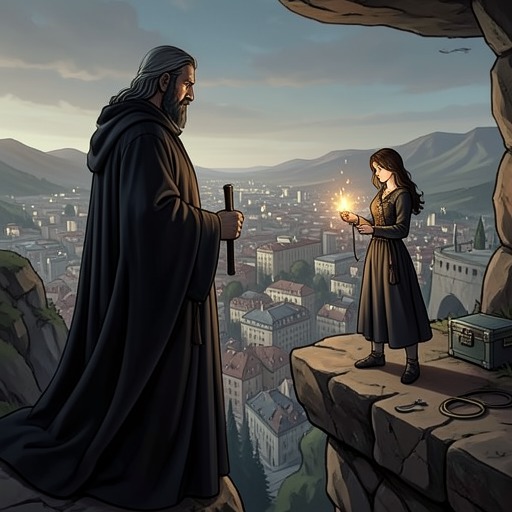
Living with 7 vampiresGehenna is the infernal realm ruled by Gehan, whom Jinyoung identifies as the figure humans call Satan. Its decisive narrative function is to turn an abstract threat into a bounded domain: Gehan can be cast back into Gehenna, but only Y/N’s newly awakened power can lock its gate and make that separation lasting.
Definition and Rule
Gehenna is presented to Y/N as the place over which Gehan exercises absolute authority. When Bambam tells her that the group is taking her to Gehan, she asks what that means; Bambam calls him the ruler of Gehenna itself, while Jinyoung clarifies that humans call the realm Hell. Y/N’s immediate question, asking whether Gehan is Satan, shows how the location enters the story through a human religious vocabulary before its supernatural political structure is made explicit.
The exchange also establishes Gehenna as a domain governed by possession and jurisdiction. Gehan insists that he is its ruler and therefore can return even after being sent away. His claim makes the gate more than a route between worlds: it is the mechanism through which his authority can be challenged, but it is not initially assumed that anyone can permanently close it.
The Blood Moon and the Gate
The confrontation with Gehan takes place under a blood-red moon. Y/N is first trapped when something tightens around her neck, leaving her unable to move. A red light then falls over her, and the blood-red moon appears above her. This celestial intervention marks the turning point of the scene, linking Gehenna’s power to blood, darkness, and ritual transformation while also creating the conditions for Y/N’s own strength to surface.
After Y/N declares that she will lock the gate to Hell, she takes a glass ball from one of Gehan’s pockets. She then pushes him away, concentrates, and imagines the gates of Gehenna into existence. The appearance of the gates is accompanied by heavy rumbling, giving the realm a physical threshold even though it has been introduced as an infernal place rather than described through ordinary geography.
Y/N’s Sealing of Gehenna
Y/N throws Gehan through the gates of Gehenna and locks them. The gate slowly disappears, and she remains holding the glass ball. The sequence changes the balance of power between ruler and subject: Gehan’s title does not protect him from expulsion, and his confidence that he can return is defeated by Y/N’s ability to close the passage itself.
The act is also connected to Y/N’s awakening. She has just discovered that she can break the chain restraining her merely by moving her right arm. Gehan appears frightened, and Y/N recognizes the contradiction in his fear of his own daughter. Her power is therefore not simply an external weapon used against Gehenna; it is bound to the lineage and force that Gehan helped create or control. The gate closes at the moment when Y/N refuses to let that inheritance determine her obedience.
Aftermath and Wider Significance
Gehenna’s closure does not erase the damage associated with Gehan’s rule. After the confrontation, Y/N’s mother reappears from a blue bubble in human form and sees what has happened. Y/N remains suspended at least five meters above the ground and challenges her mother’s apparent concern by asking whether she intends to take the power away and make it her own. She then compares her mother with her father, suggesting that both parents are implicated in the struggle over Y/N’s supernatural abilities.
Assiah later explains that Y/N had been possessed by her own power. This interpretation places Gehenna within a larger system of unstable inheritance, curse, and bodily control rather than treating it as an isolated underworld. The same aftermath reveals Gehan’s mark on Bambam’s wrist; Bambam has a hole through his chest from trying to stop Y/N, and Assiah says that the group has been under the curse for too long. Gehenna thus remains present through the marks, injuries, and relationships produced by Gehan’s influence even after its gate has vanished.
Narrative and Mythic Function
Gehenna combines several kinds of threshold at once: a religious image of Hell, a ruler’s territory, a gate that can be opened and sealed, and the inherited source of a family conflict. Its role is not merely to provide a frightening setting. The realm gives spatial form to the question of who may control Y/N’s body and power. Earlier, V reduces Y/N to the castle’s only blood vessel, while Y/N rejects that status; at Gehenna’s gate, she reverses the same logic of possession by treating Gehan’s domain as something that can be entered, closed, and denied to him.
The blood moon, the recovered glass ball, the mother’s appearance, and the mark on Bambam’s wrist organize Gehenna as a ritual landscape of bloodline and captivity. Yet the ending refuses to leave Y/N as a passive heir to an infernal order. By sealing Gehenna rather than accepting Gehan’s rule, she converts the realm from an inevitable destiny into a boundary under her own control. Gehenna’s lasting significance therefore lies in the distinction between having power through descent and exercising power through choice.